Weathering geomagnetic storms
The Russians have a new take on preventative medicine. In a room at the Georgian Techni-cal University (GTU) in Tbilisi, three sets of Helmholtz coils dotted about the place bathe the room in a powerful magnetic field. The plan is to begin using this set-up for cardiovas-cular patients, particularly those in intensive care, with the coils offering compensatory shielding against an invisible threat—a killer that is more potent than diet, lifestyle or even genes.
We all live on what is essentially a giant magnet, with its North and South Poles—the two poles of the magnet—surrounded by a donut-shaped mag-netic field. This ambient geomagnetic field, or magnetosphere, is constantly in flux, as it’s affected by the weather and any geological changes on earth— but, most particularly, by volatile changes of the weather in space, largely caused by the furious activity of the sun.
This benign star responsible for all life on earth is essentially a cluster of unimaginably hot hydrogen and helium criss-crossed with a layer of unstable magnetic fields. Not surprisingly, this volatile combination results in periodic volcano-style eruptions that propel gas into space, while vortices of concentra-ted fields—the dark blobs on the sun’s surface that we call ‘sunspots’—pull apart and reconnect to form new arrangements. Despite this potentially anarchic combination, the sun carries out this activity according to a fairly predictable timetable; regular solar cycles consist of 11 years, during which time sunspots build up, discharge and begin to wane.
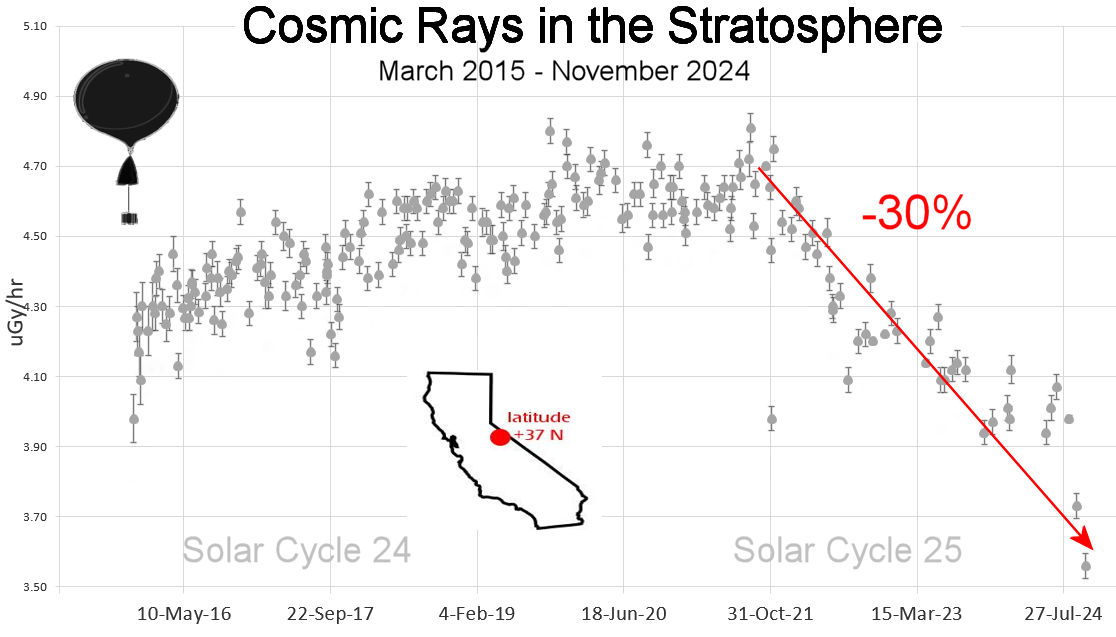
During the waxing stage, as sunspots accumulate, so the sun begins to hurl its gaseous explosions, such as solar flares, our way. This amounts to a billion ton’s worth of gas and magnetic fields with the force of billions of atomic bombs, all made airborne and aimed towards earth through the electrified gas of the solar wind—and all travelling some five million miles per hour.
This activity not only causes extreme geomagnetic storms in space but also, during moments of intense solar activity, penetrates the earth’s magnetic field. During any given 11-year solar cycle, we can expect to experience two years’ worth of geo-magnetic storms severe enough to disrupt portions of the earth’s electrical power, interrupt high-tech communications systems, and dis-orientate spacecraft and satellite navigation systems.
Profound effects on life
Until only recently, scientists were dismissive of the idea that the earth’s faint magnetic field—a thousand times weaker than the standard classroom horseshoe magnet—had any effect on basic biological processes, particularly as all living things on earth are now exposed to much stronger electromagnetic and geomagnetic fields at every moment of our modern, technologically dependent, lives.
Nevertheless, the latest discoveries have revealed that living things have a small window through which subtle geomagnetic and electromagnetic fields—such as those generated by the earth, rather than the artificial kind generated by technology—have the most profound effect upon all cellular processes in living things. Changes in this faint charge, particularly those of extremely low frequencies (less than 100 Hz), profoundly influence virtually all biological processes in living things and, in particular, the two major engines of the body—the heart and the brain.
The earth’s magnetic activity appears to directly affect our cell membranes and calcium-ion channels, which are vital for regulating enzyme systems within the cell. In particular, the earth’s geomagnetic field appears to target the sympathetic nerves (those originating from the chest and lower-back parts of the spinal cord, and include the ‘fight-or-flight’ response).
Of all the affected systems in the body, changes in solar geomagnetic conditions most profoundly disturb the rhythms of the heart. Indeed, in susceptible people, magnetic storms can bring on a heart attack. Healthy hearts have a wide range of variation in heart rate, but magnetic storms decrease heart-rate variability (Biomed Instrum Technol, 1999; 33: 152–87) and, in turn, increase the risk of all coronary artery disease and heart attack. When geomagnetic activity increases, the blood becomes thicker—sometimes doubly so—and the bloodstream slows down, both of which are a recipe for a heart attack.
In fact, heart-attack rates and cardiovascular deaths closely follow increases in solar-cycle geomagnetic activity (Neuro Endrocrinol Lett, 2000; 21: 233–58), with the largest number of sudden fatal heart attacks occurring within a day of a geomagnetic storm (Solar Physics, 1977; 51: 175–83). One University of Minnesota study found a 5 per cent increase in heart attacks during times of maximum solar activity over a five-year period (J Atmos Solar-Terr Phys, 2002; 64: 707–20).
Besides heart effects, the sun has a profound effect on the other electrical centres of the body: the brain and nervous system. Scientists in the Soviet bloc discovered that, even in healthy volunteers, electrical activity in the brain is highly destabilized during magnetically stormy days (Proceedings of the Space Weather Workshop: Looking Towards a European Space Weather Programme, December 17–19, 2001, Noordwijk, The Netherlands). Indeed, the nervous system’s signalling itself is corrupted, so that parts are overactivated while others fail to fire (Astron Astrophys Trans, 2003; 22: 861–7).
Geomagnetic activity in space also profoundly affects mental stability: the higher the geomagnetic activity, the greater the increases in general psychiatric disorders (Percept Motor Skills, 1992; 74: 449), the greater the number of patients hospitalized for nervous conditions and the greater the number of attempted suicides (Int J Biometeorol, 1994; 38: 199–203).
There is even some evidence that epileptic fits result from or are exacerbated by geomagnetic disturbances (Braz J Med, 1996; 29: 1069–72).
An early-warning system
The above-mentioned GTU experi-ment was part of BIOCOS (Biosphere and Cosmos), a vast multicentre project begun by noted biologist Franz Halberg and University of Minnesota’s Chronobiology Laboratories to act as an early-warning signal by monitoring the physiological variables caused by the sun and other planets.
The project specifically targets a phenomenon called CHAT (circadian hyperamplitude tension)—excessively high blood pressure during part of the day caused by solar or other planetary activity. During times of geomagnetic disturbance, for instance, heart patients may be advised not to exert themselves or engage in any sudden strenuous activity. Alternatively, as heart infections often follow heart attacks, they could be given antibio-tics as a preemptive strike.
The Phoenix Ambulatory Blood Pressure Monitor Project in the Twin Cities of Minnesota offers ambulatory blood-pressure monitoring so that patients can follow any arterial effects when solar activity is at its peak.
However, it may take many more years before orthodox medicine accepts the notion that, in the more susceptible, biology is controlled not from within, but by the wild and explosive activity of the sun.
Lynne McTaggart
The sun’s activity in the form of CME’s, HSS’s, Space wind, Coronal Hole emissions [sun spots] interact with the magnetosphere. This in turn during a magnetic storm causes the Schumann Resonance [average of 7.8 Hertz], this resonance envelops the Earth, and is the same frequency as our hearts and brains attenuate too. The result when the frequencies are disturbed are outlined above in the article.
By reading the lengthy link below, it explains more of the above and below in detail. Interesting to note in A and E, emergency rooms in hospitals world wise, often EEG readouts are identical or almost identical to the GCI random event generators or GCI data collectors, which are able to monitor and graph the Earth’s Magnetic Field., and the collective unconscious. This infers that the hearts and brains of biological organisms are linked and interact with the Earths Magnetic Field and Magnetosphere, which in turn is influenced by the Sun Activity and the Sun maybe influenced or in resonance with the vast Black Hole at the Centre of the Milky Way.
http://www.glcoherence.org/monitoring-system/commentaries.html?mtcCampaign=9228&mtcEmail=13526879
STORMY WEATHER
Many of us are preoccupied with whether or not the recent blizzards, flooding, intense heat waves and other extreme weather are related to global warming. But, what we haven’t stopped to consider is how these extreme weather conditions may be affecting our own health.
Lightning and thunderstorms create very-low-frequency (VLF) atmospherics, or ‘sferics’. These are short, weak electromagnetic fields (EMFs) in the 1–100 kHz range that settle down to a common frequency of 10 Hz, which is tiny compared with the much higher frequencies bombarding us from our computers, TVs and electrical appliances. Nevertheless, growing evidence shows that all living organisms respond to buildups of EM energy from the weather on earth, and that these faint, dampened impulses profoundly affect all of our biological systems—and possibly far more than does the sea of EM ‘noise’ all around us.
Weather-weary
The level of circulating sferics largely accounts for what is being termed ‘meteoropathy’, or illness due to the weather. According to German research, some 30 per cent of Europeans are weather-sensitive (J Sci Explor, 1998; 12: 455–68). Those affected react to changes in air pressure, humidity and even temperature. During buildups of sferics, pain is intensified, illness increases, moods worsen and people get the ‘blahs’.
Researchers at the Department of Clinical and Physiological Psychology at the Justus Liebig University of Giessen, Germany, have discovered that pain from all manner of sources—scars, brain injury, angina, asthma or migraine—is more intense during high rates of atmospherics, with increases beginning one or two days before a change in the weather (Reiter R. Meteorobiologie und Elektrizität der Atmosphäre [Meteorobiology and Atmospheric Electricity]. Leipzig: Akademische Verlagsgesellschaft [Academic Publishers] Geest & Portig, 1960).
When sferics are high—say, during geomagnetic storms—blood viscosity (stickiness) also dramatically increases, as do heart attacks (Clin Cardiol, 1985; 8: 149–51). They also increase the pain of rheumatism, migraine, sleep disorders and general tension. Bad weather also appears to have a profound effect on human mood. Violence, accidents (including traffic accidents), suicides and criminal behaviours increase when EMFs build up in the air (J Sci Explor, 1998; 12: 455–68).
Atmospherics can also interfere with concentration. Students make more mistakes on tests when sferics were high the night before. Our ability to react quickly also suffers when the air is heavy with sferic activity.
But why do we feel these faint pulses and not the louder ones? The Giessen group pos-tulates that each of us possesses a biological ‘window’ through which we receive and respond to a specific band of frequencies.
Thus, we are only susceptible to waves that correspond to our ideal frequencies.
Participants exposed to 10-kHz sferics for only 20 minutes show a large shift in their alpha band (7–13 Hz), the wave length of meditation and alert receptivity (Tirsch WS et al. ‘Spectroanalytical investigations about the influence of atmospherics on the human EEG’ [Abstr]. EEG Symposium, Obergugl, February 1994). Other studies have shown an increase in both alpha and beta brain-wave activity (13–40 Hz).
In our human evolution, the brain may have worked best when tuned in to 10 Hz, the frequency of our alpha cycle—quiet, meditative alertness—and the same as the Schumann resonance, the most common frequency of EM waves that encircle the earth.
Keeping time
James Oschman—author of Energy Medicine: The Scientific Basis (Churchill Livingstone, 2000)—believes that, when we’re in a relaxed or meditative state, the pulse of the earth takes over as our brain’s ‘pacemaker’. Some have even concluded that the Schumann resonance frequency creates our own internal rhythms. When people in an underground bunker were exposed to Schumann-like extra-low-frequency (ELF) waves for a week, they displayed more accurate circadian rhythms than did the controls (Naturwissenschaften, 1968; 55: 29–32).
The Giessen group has also examined reports showing that these low, faint fields can affect cell calcium, as all the important ions of the body are in the low-frequency range. Such interaction affects the delicate balance of melatonin and serotonin, the brain hormones that regulate mood, set our circadian rhythm and may be involved (through the pineal gland) with the workings of a number of the major organs.
The brain uses these oscillating cellular calcium ions to regulate a range of bodily functions. Like the rhythm set by an orchestra conductor, the 10-Hz pulse of the earth’s weather gives us the world’s best beat. As a tuning fork tunes a musical instrument, it may be that we need to be ‘tuned’ by the Schumann resonance to be at our own peak performance.
Also, we may have evolved to pick up these changes in the weather several days in advance to give us enough time to find food or shelter, say the Giessen scientists.
The Schumann VLF fields build up primarily during fair weather. So, it may well be that we humans were designed to function at our best when it’s sunny, and to give in to the impulse to hibernate during stormy weather.
Lynne McTaggart
WDDTY VOL 20 NO 11
Medically speaking the magnetic erratic behaviour could be treated by beta blockers, aspirin, and blood thinners as the activity can cause temporary arrhythmias, AF, high blood pressure and viscosity, only to subside after the storm. As above the Russians treat it with Helmholtz Coils. However, the side effects of drugs and the cost to medical authorities could be averted if the magnetic coils were issued to those sensitive to Weather and Sun activity.
emWave from the HeartMath Institute http://www.heartmath.com/about/institute-of-heartmath.html have powerful instruments and techniques for bringing the heart and brain into coherence. Doasone website does focus breathing. Meditation providing it is not [imagery, auto suggestion, visualisation, hypnosis, prayer or imagining a guru or religious figure, chanting], can facilitate coherence.
http://www.doasone.com/
‘The physical condition of early Astronauts deteriorated severely whilst in Outer Space, away from the Schumann Resonance. The problem was solved by introducing the "Schumann Simulator" into all space shuttles, a magnetic pulse generator mimicking the Earth's frequency. This demonstrates the simple fact that we cannot be healthy if disconnected from the "natural biological frequency" ‘
‘As the Pineal Gland is affected by changes in the Earth's magnetic field, so is our hormone production. In particular, Melatonin, an important Neuro Hormone and oncostatic (cancer surpressing) agent, is not produced in the absence of the Schumann Resonance in outer Space and its production is throttled in the presence of electromagnetic pollution.
So Melatonin seems to have a very close link with the "Optimum Biological Frequency Resonance". It also has been established that the Schumann Resonance is in some way a "window frequencies" for growth hormone release. If we take on board that the natural frequency is gradually being drowned out whilst our biological systems are still tuned into that frequency, then we must look for ways in which we can tune ourselves back into that frequency. It might be our only chance of maintaining a healthy immune system.
When we consider the possibility of a future governed by technology mainly involving pulsed microwaves, the outlook is frightening. But it is only frightening when we chose to ignore the simple fact that we are electromagnetic beings sensitive to electromagnetic radiation. Everything depends on the right frequency. The right frequency can enhance, whilst the wrong frequency can destroy’
http://www.schumannresonator.com/
A brilliant article on the history of Schumann Resonance, diagrams, graphs, and detailed synopsis of the whole spectrum of frequencies.
http://www.glcoherence.org/monitoring-system/commentaries.html?mtcCampaign=9228&mtcEmail=13526879
This link is extensive; however, it covers everything and anything to do with the interconnectiveness and biology.
http://www.energygrid.com/futurity/geoff-freed/2010/12.html First ¾ of blog shows interconnectiveness and interrelationships of Solar, Earth Magnetic fields.
Thank you for reading this and trust it helps.
Lets Hope The Ride of the CME’s is not as severe as some forecast.
Lots of Love, courage and best wishes. Geoff
http://apod.nasa.gov/apod/
Copyright © 2012 Geoff Freed





No comments:
Post a Comment
Note: only a member of this blog may post a comment.